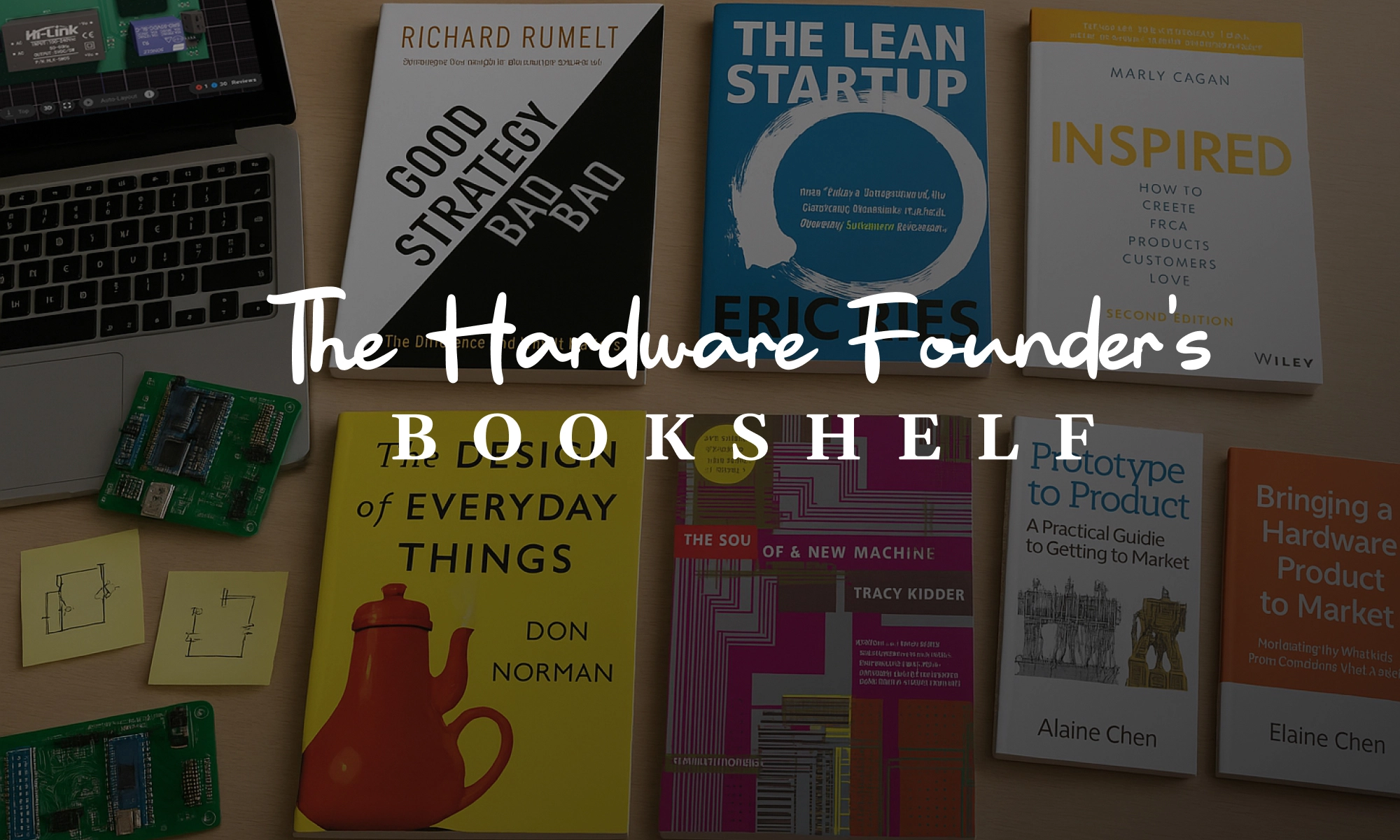


At Flux, we see hardware entrepreneurs sign up every day with the same dream: take an idea, ship it to the masses, and turn it into a sustainable business. Having worked with and invested in hundreds of startups, I’ve seen both the successes and the struggles.
Here’s the hard truth: most hardware startups don’t fail because they can’t build a prototype or find a manufacturer. While still difficult, technical execution is getting easier every year—modern tools, AI included, are streamlining that part of the journey. What kills most teams are the missed fundamentals:
Hardware raises the stakes because iteration is slower and costlier. You can’t afford to stumble on business basics, design fundamentals, or customer insight. The teams that win are the ones that maximize their rate of learning—by de-risking the business model while iterating the product as fast as possible.
That’s why we put together this bookshelf. It’s not just about engineering or manufacturing (though you’ll find the best guides here). It’s about sharpening judgment, broadening perspective, and giving technical founders the tools to build companies people love.
For hardware founders, the hardest part usually isn’t the prototype—it’s building the company around it. These books focus on judgment, focus, and leadership: how to move fast without losing clarity, protect the details that matter, and make the calls that keep a small team alive. They’re about operating at founder speed when time, money, and attention are always scarce.
{{book-set-1}}
{{underline}}
Hardware doesn’t forgive sloppy execution. Once you leave the lab, mistakes multiply—costs rise, timelines slip, and quality issues get baked into production. These books help founders treat manufacturing as part of the product itself: learning to engage suppliers early, de-risk decisions, and build systems that scale without collapsing under their own weight.
{{book-set-2}}
{{underline}}
Every hardware founder eventually gets burned by the basics. Power rails, grounding, EMI, provisioning flows—these are where folklore and half-remembered rules can cost you entire boards. These books turn “tribal knowledge” into principles you can rely on, helping you avoid expensive surprises and design products that actually hold up in the field.
{{book-set-3}}
{{underline}}
Great hardware isn’t just about circuits and enclosures—it’s about making something people actually want to use. These books teach the fundamentals of design thinking, product discovery, and usability. For hardware founders, they’re the bridge between technical execution and customer love—the difference between a product that works and a product that wins.
{{book-set-4}}
{{underline}}
Building hardware is a long, uncertain grind. Sometimes what you need isn’t another playbook—it’s proof that others have walked this road before. These books capture the culture, discipline, and stubbornness of teams who built under pressure, kept their vision intact, and shipped work that mattered.
{{book-set-5}}
{{underline}}
These books shape how we think at Flux, but the real progress comes from learning together. That’s why we created the Flux Hardware Slack Community. It’s where founders connect to:
You can also book design reviews with the Flux team to receive actionable feedback before you head to production. Please let us know if there are other resources you’d like us to provide that could your hardware startup become a massive success! We’re here to help.
Here’s the hard truth: most hardware startups don’t fail because they can’t build a prototype or find a manufacturer. While still difficult, technical execution is getting easier every year—modern tools, AI included, are streamlining that part of the journey. What kills most teams are the missed fundamentals:
Hardware raises the stakes because iteration is slower and costlier. You can’t afford to stumble on business basics, design fundamentals, or customer insight. The teams that win are the ones that maximize their rate of learning—by de-risking the business model while iterating the product as fast as possible.
That’s why we put together this bookshelf. It’s not just about engineering or manufacturing (though you’ll find the best guides here). It’s about sharpening judgment, broadening perspective, and giving technical founders the tools to build companies people love.
For hardware founders, the hardest part usually isn’t the prototype—it’s building the company around it. These books focus on judgment, focus, and leadership: how to move fast without losing clarity, protect the details that matter, and make the calls that keep a small team alive. They’re about operating at founder speed when time, money, and attention are always scarce.
{{book-set-1}}
{{underline}}
Hardware doesn’t forgive sloppy execution. Once you leave the lab, mistakes multiply—costs rise, timelines slip, and quality issues get baked into production. These books help founders treat manufacturing as part of the product itself: learning to engage suppliers early, de-risk decisions, and build systems that scale without collapsing under their own weight.
{{book-set-2}}
{{underline}}
Every hardware founder eventually gets burned by the basics. Power rails, grounding, EMI, provisioning flows—these are where folklore and half-remembered rules can cost you entire boards. These books turn “tribal knowledge” into principles you can rely on, helping you avoid expensive surprises and design products that actually hold up in the field.
{{book-set-3}}
{{underline}}
Great hardware isn’t just about circuits and enclosures—it’s about making something people actually want to use. These books teach the fundamentals of design thinking, product discovery, and usability. For hardware founders, they’re the bridge between technical execution and customer love—the difference between a product that works and a product that wins.
{{book-set-4}}
{{underline}}
Building hardware is a long, uncertain grind. Sometimes what you need isn’t another playbook—it’s proof that others have walked this road before. These books capture the culture, discipline, and stubbornness of teams who built under pressure, kept their vision intact, and shipped work that mattered.
{{book-set-5}}
{{underline}}
These books shape how we think at Flux, but the real progress comes from learning together. That’s why we created the Flux Hardware Slack Community. It’s where founders connect to:
You can also book design reviews with the Flux team to receive actionable feedback before you head to production. Please let us know if there are other resources you’d like us to provide that could your hardware startup become a massive success! We’re here to help.



Voltage regulators ensure stable power in electronics. This post covers types, uses, and selection tips—plus how AI tools like Flux.ai streamline design.
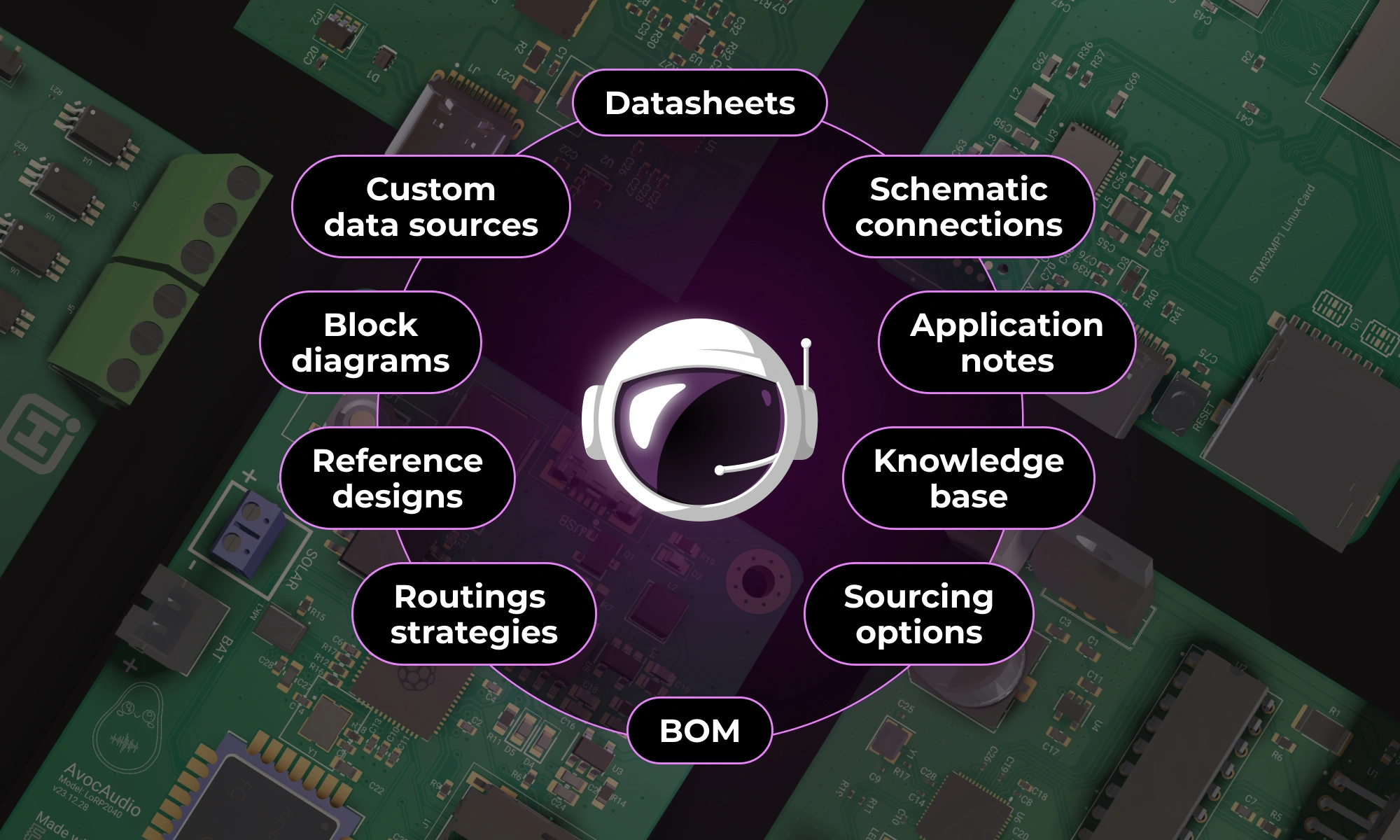
This post will give you a deeper understanding of how Flux Copilot works, how large language models (LLMs) and agentic systems operate under the hood, and why grounding them in engineering context matters.

Understanding amps and volts is key to working with electronics. This guide explains their roles, relationship, and practical applications.
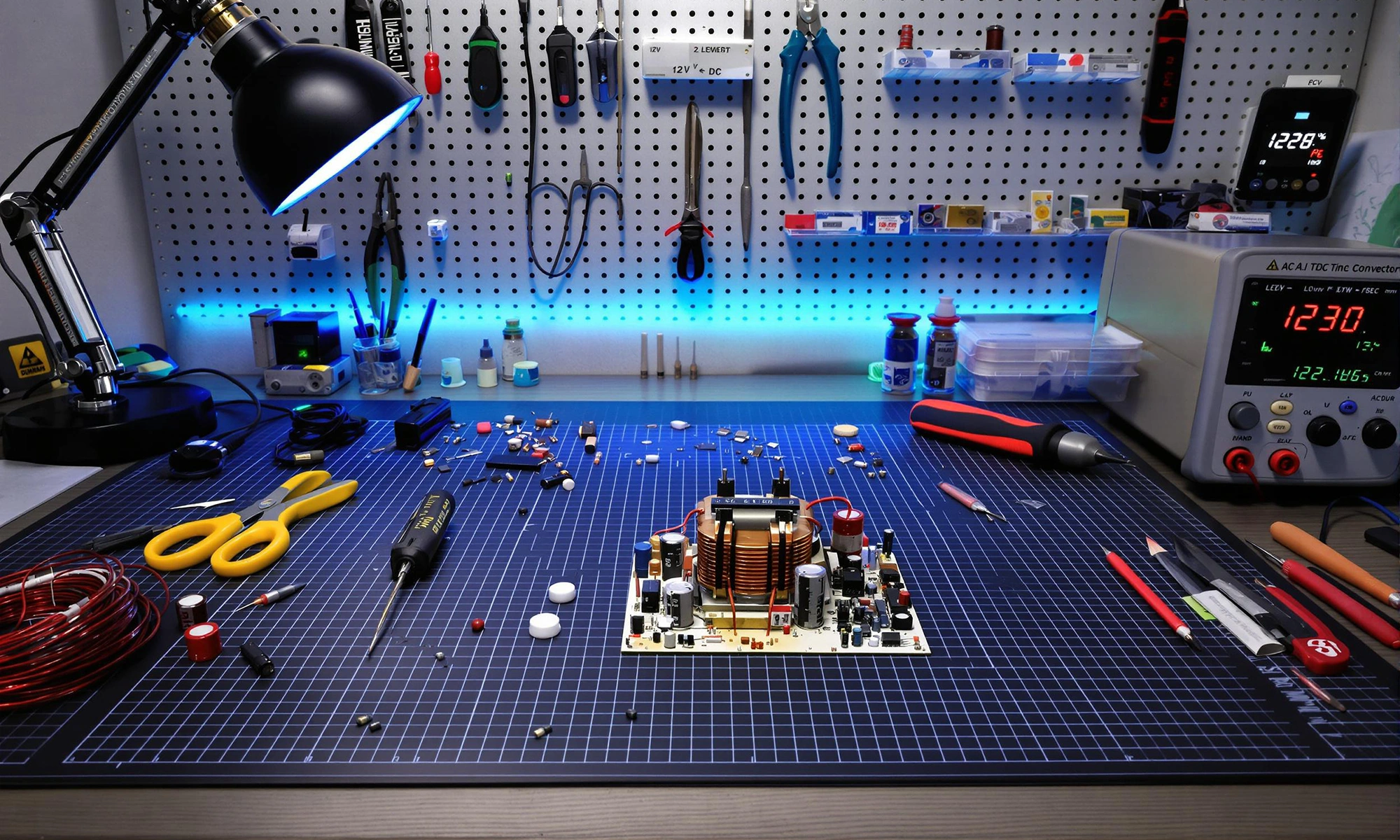
AC to DC converters transform wall power into the stable DC voltage electronics need. They work by rectifying AC, filtering ripples, and regulating output. These converters power everything from phones to server racks and are evolving with efficient, compact technologies.

This article highlights 10 of the most popular microcontrollers, based on their usage in embedded systems, memory architecture, and the community support they enjoy.

Learn five practical tips to improve PCB routing with AI Auto-Layout, including differential pairs, power traces, rule sets, zones, and convergence strategies.

The SNES controller revolutionized gaming with its ergonomic shape, responsive buttons, and innovative shoulder controls. Its design set the standard for modern controllers. Even today, it remains a blueprint for comfort and precision in input devices.

We’re excited to announce our partnership with Ultra Librarian to bring millions of high quality and trustworthy components directly to the Flux ecosystem. This partnership marks a big step towards bringing together all semiconductor manufacturers, distributors, engineers, and the whole hardware industry.
This blog highlights CES 2025 showcased projects, offering insights on how to recreate them using Flux. With Flux AI-driven design tools, component library, and customizable templates, engineers and hobbyists can build inspired hardware like wearables, drones, EV components, portable chargers, and solar devices.

The Raspberry Pi Zero 2 W is a small and powerful computer with impressive performance for its size and price. With a quad-core processor, 512MB of RAM, built-in wireless connectivity, and a USB On-The-Go port, it's suitable for many projects, including home automation, media centers, and robotics.

RP2350 A4 fixes GPIO bug, hardens security, adds 5 V tolerance and on-chip flash. See why every Pico project should migrate.

This blog post highlights a series of innovative reference designs developed by renowned manufacturers using Flux. These reference designs encompass a variety of applications, including advanced light sensing, robust data communication, and compact distance measurement. This diverse array showcases the adaptability and effectiveness of Flux in meeting the varied needs of industrial sensing applications